
Clinical memory: the real subject of hospital digitalisation
A West African hospital experiences on average 5 to 15 power outages per week, totalling more than 8 cumulative hours. When an EMR project has not been designed to absorb those outages — under-sized…
There are stories that look the same from one hospital to the next. The patient who comes back to the emergency room ten years after their last visit, and the team takes time to find them in the archives. The doctor who prescribes a medication already prescribed elsewhere, because the information was not in front of them. The family that waits an hour for an administrative document that, on paper, takes two minutes to issue.
In our hospitals and large university teaching hospitals, these situations are frequent — and they are not the fault of any one person in particular. A study published in 2025 in Health Research in Africa collected 284 questionnaires from caregivers, archivists, patients and family members. It offers an honest picture of the situation: 98.7 % of patient records are still on paper, two out of three respondents indicate there is no dedicated archive room, and 90 % do not know the precise retention schedule in force.
This finding is not a sign of bad will. It reflects a simple reality: the country's health centres exist to care, not to administer document systems. Their job is the patient. Records management is one more burden, with resources and time already lacking elsewhere. This is exactly where Risin Health steps in, to bring the people, the tools and the method that are so often missing.
What a fragmented memory costs care
The most telling figure in the survey has nothing to do with paper. It has to do with care itself: 52 % of respondents believe the current records management has a direct negative impact on medical care.
In practice, this can translate into:
- caregiver time spent rebuilding a clinical history the patient has already told several times;
- decisions made without all the information available;
- confidentiality harder to protect when a file circulates without a clear trace.
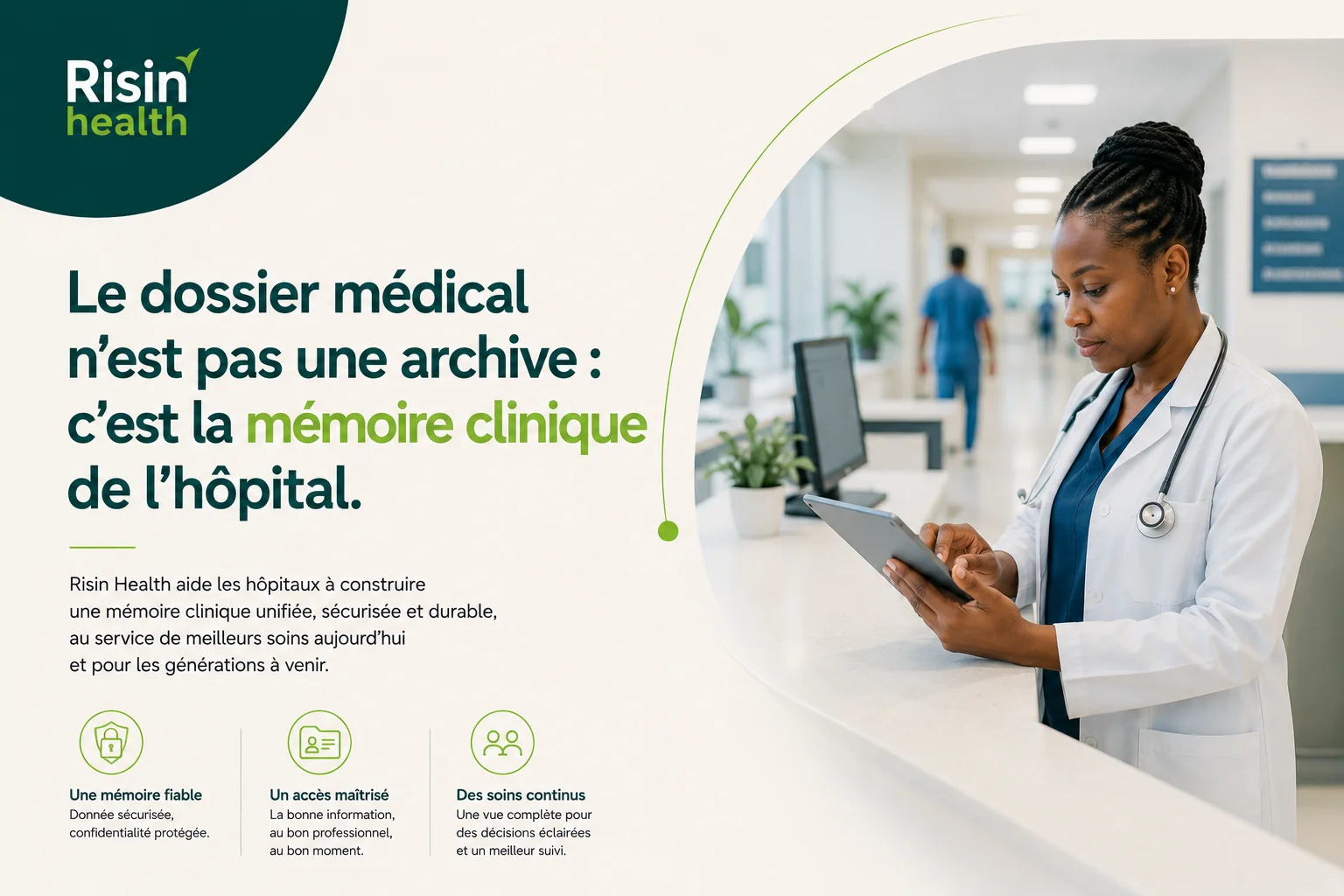
The medical record is not just an administrative document: it is clinical memory. When that memory fragments, continuity of care suffers. This is also exactly what Risin Health helps its partner hospitals rebuild, file by file, alongside the teams already in place.
A legal framework that exists, a method to consolidate
The country has a clear legal framework: law no. 2013-450 protects personal data, and the Data Protection Authority publishes its texts on its official website. Yet 80 % of those interviewed in the study say they do not know the details of these texts — a gap in information rather than a voluntary compliance issue.
The study also notes an internal practice, set by the head of archives at the facility concerned: a 100-year retention period for patient files. This figure reflects a desire to do the right thing.
In other words, teams are moving forward with the resources they have, doing their best. It is a perfectly solid starting point — and it is exactly the kind of situation where Risin Health intervenes, alongside on-site teams, to turn these good local practices into a structured and lasting system.
The real subject is patient identity
Digitising a stack of files is not enough if each stack ignores it is talking about the same person.
The first building block to put in place is a unique patient identity, valid from reception to consultation, from the laboratory to the pharmacy, from billing to hospitalisation. Without it, a single patient can end up with several different files depending on which service saw them first. This is also the first thing Risin Health puts in place with its partners: a shared patient index, governed and reliable over time.
Then comes the method. Digitising is not photographing. Each document gains by being linked to:
- an identifiable patient;
- a dated care episode;
- a document type (consultation, imaging, biology, operative report);
- a confidentiality level;
- an author, a date of modification, a trace.
With this structure, we build a truly useful, searchable archive that grows with the facility.
The long run: a challenge to anticipate together
An Ivorian medical archive must now meet a retention requirement of more than 90 years — a horizon longer than the lifespan of most software, file formats, and even the IT directorates that choose them.
Paper can survive a long time. Digital needs to be supported to last.
This is why a long-lasting digital archive must be thought of as infrastructure, not just software. It requires:
- backups that are tested, not just scheduled;
- replication to a second site;
- regular integrity checks;
- document formats readable in fifty years;
- a migration plan, because technology moves faster than 90 years.
This is a topic Risin Health anticipates from the design of its platform, with long-term preservation mechanisms and format migrations designed to last decades alongside partner facilities.
The right of access, or how to give the right information to the right person
The doctor caring for a patient does not have the same information needs as the cashier, the archivist or the network administrator. Distinguishing these roles well avoids two pitfalls: access impossible when legitimate, and access too broad when it is not.
A well-designed archive traces every consultation: who saw what, when, why. It can answer a patient who wants to know who consulted their file. It can also properly deny an access that has no reason to be. This is one of the pillars of governance that Risin Health puts in place with its hospital partners.
The indicators that show things are moving
A digitalisation measured by the quality of the scan misses the essential. What matters are concrete indicators:
- how many patients have a verifiable unique identity;
- how many priority files have been digitised and quality-checked;
- how many files are retrieved without manual search;
- the median time to retrieve a file;
- the number of residual duplicates;
- the number of archive consultations traced;
- the number of successful restore tests in the last month;
- the number of confidentiality incidents reported.
An indicator that does not move for six months deserves a closer look — it is a useful signal, not a judgement.
A situation shared by many countries
This challenge is not unique to one facility or one country. It is a global transition, at different rhythms depending on the region.
The State of Digital Health 2023, built from the responses of 67 countries to the Global Digital Health Monitor, illustrates this well: 40 % of participating countries were at phase 3 of digital maturity, 33 % at phase 2, only 22 % at phase 4. And 90 % of the countries studied covered only part of their national digital health needs.
Buying software is not enough — but it is not a dead end either. What often makes the difference is governance, standards, skills, and a preservation method that outlives the software itself. That is what Risin Health brings: field expertise, tools suited to low-connectivity environments, and support that does not stop at delivery.
What a well-thought-out archive changes in practice
Paper has not said its last word. It remains useful as evidence, as a source, as a safety net. But it can no longer, alone, carry the memory of a facility expected to retrieve a file across several generations.
Thought of as infrastructure rather than a simple IT project, digitalisation brings three things that paper alone cannot:
- a unified identity that follows the patient from one service to another, from one decade to another;
- access traceability that protects both the patient and the professional;
- backup and migration capability that turns the archive into heritage rather than a burden.
It removes nothing from the facility's responsibility. It makes it more readable, more measurable, easier to defend — and it is this equipped chain of responsibility that Risin Health builds with its partners, step by step.
The test that really matters
Let us imagine a patient returning to the facility fifteen years after their last consultation. The team looks for their file. In a paper system, they hope to find it. In a well-governed digital system, they find it and they know who has accessed it in the meantime.
It is this small test, repeated hundreds of times over twenty years, that shows whether an archive holds up. It is precisely on this ground that Risin Health chooses to stand: alongside facilities, for the long run.
Sources
- La Gestion des Archives Médicales en Côte d'Ivoire, Health Research in Africa, 2025. Download
- Autorité de protection de Côte d'Ivoire — Lois. Lois – Autorité de protection
- The State of Digital Health 2023, Global Digital Health Monitor. static1.squarespace.com/static/5ace2d0c5cfd792078a05e5f/t/656f97969301e337ada15270/1701812128734/State+of+Digital_Health_2023.pdf